


I spend a lot of time talking about gatekeepers in publishing, but my role has never been to stand in front of the gate. It's to help writers get through it.
I've believed in Montecito by Michael Cox for a very long time, and one of the reasons I'm excited to share his story is that it illustrates something I wish more writers understood: a rejection is not always a verdict. Sometimes a good book simply hasn't found its path yet.
Reading Michael's essay was a little surreal because he describes an eleven-year roller coaster. From where I was sitting, it never felt like one. There were setbacks, certainly, but I never stopped believing the book worked. To me, it always felt like Michael just hadn't found his readers yet.
Here's Michael's story, in his own words.
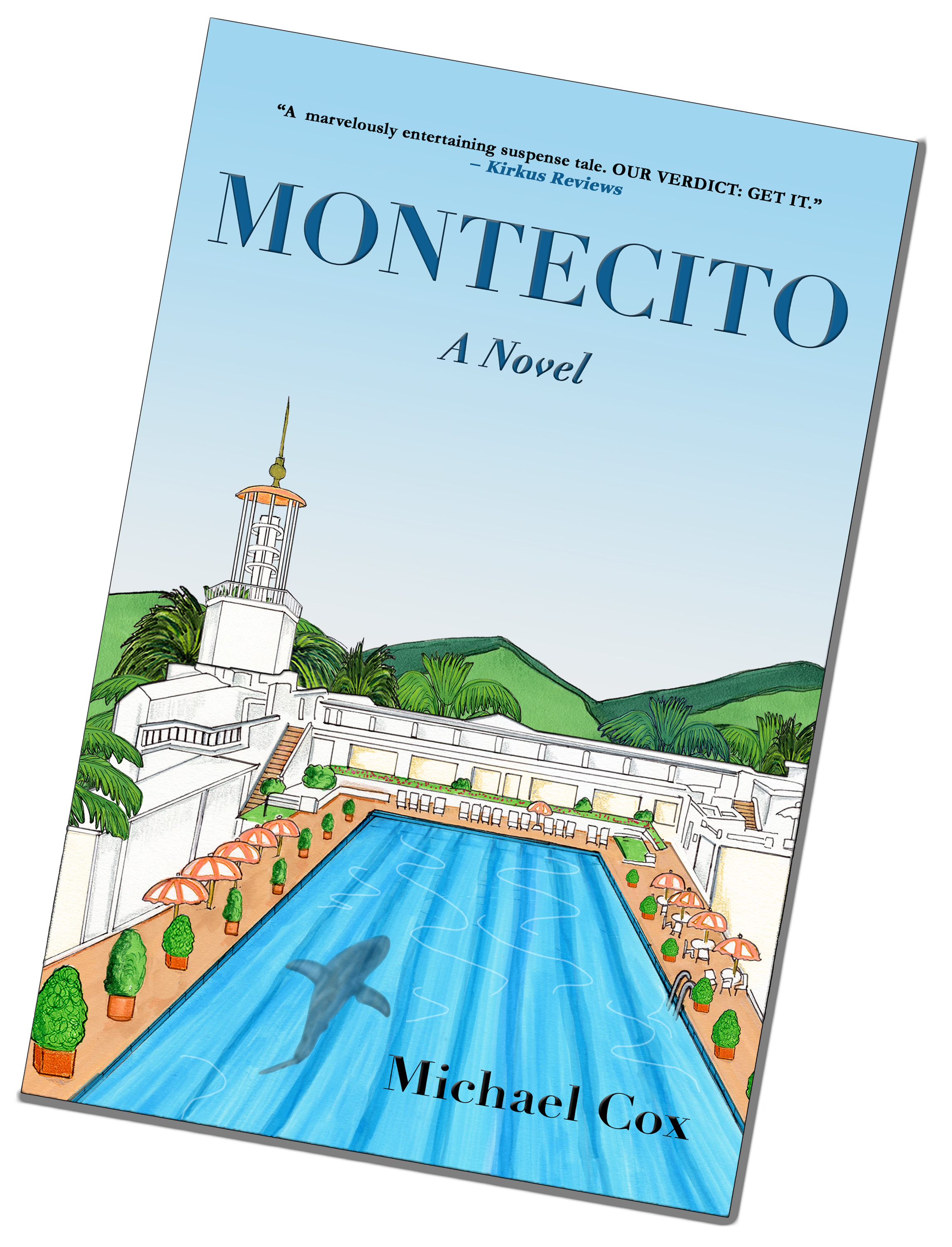
My novel, Montecito, was published this week. It’s the culmination of an eleven-year tilt-a-whirl ride, including six years with Kristen Weber seat belted in beside me. And even as this grinding experience has taught me that the secret to happiness is low expectations, I can’t shake a dogged sense of hopefulness for my debut novel’s prospects.
Montecito received excellent literary reviews: a “Critical Recommendation” from Kirkus Reviews and a “Starred Review” from Independent Book Review top the list. It has a 4.4-star rating from the notoriously tough graders on NetGalley, a 4.5-star rating on Goodreads, and a 4.8-star rating on Amazon. Ingram – the world’s largest distributor of books – named it to their “Indie Early Buzz” list for June releases, and over the last month, twelve thousand people entered Goodreads giveaway contests to receive a copy of a book written by a nobody. But perhaps most exciting of all, in the three days since Montecito was released, it hit #1 on Amazon’s Hot New Releases board for one of its Literary Fiction subcategories.
These are all positive indicators, guaranteeing nothing. Nevertheless, I have hope—that most dangerous of four-letter words.
But my present hopefulness is not the point of this post. As Kristen has reminded her followers on many occasions, focusing only on the final joyous act of birthing a novel is to miss the real story. So, here’s mine.
In early 2020, my first novel landed a literary agent. The agent had all the bona fides and professed their undying love for my work. They took novel #1 to market in March of 2020 when a little thing called Covid was becoming a big thing. As a result, the publishing world was suddenly uninterested in my workplace drama oriented around the Great Financial Crisis.
When I look back on this first defeat from today’s vantage, I recognize something I did not at the time. The industry had rejected novel #1, and I accepted it and set the project aside. I was disappointed, but unbowed. Already I was excited about my next story, Montecito. It wasn’t yet what it needed to be, but I could see its future, and I believed in that story in a way that bound it to my heart. Novel #1 was a way station; Montecito was a destination.
I share that reflection not because I’m an enlightened guru, but because one of the most important skills a writer needs on the journey to launching a career is the understanding of when to set a project aside and when to dig in. Novel #1’s rejection hurt, but instinct encouraged me to move on. Later in my journey, the same instinct would not let me move on. Pivoting and entrenching both take courage, but all forms of courage aren’t wise. The trick to honing your wisdom is learning how to read your internal barometers and—when the marketplace disagrees—having a trusted mediator seat-belted in beside you.
But I digress. While novel #1 had been rejected, all hope was not lost. I have an agent now! I reminded myself. I got back to work, and a few months later, sent my then agent a second draft of the novel that would become Montecito. The agent responded in the preferred manner of the publishing industry: they ghosted me. I’ll admit, this was not an auspicious beginning.
At this moment in my story, I was introduced to Kristen Weber, and I say with no exaggeration that Kristen leveled up my writing in ways I had not imagined were needed or possible. By early 2022, a commercially viable Montecito was complete. In the subsequent years, there would be modifications, edits, suggestions, and revisions, but the foundation and framing never changed.
For months, I queried into the void without an echo while working on my third novel. In the summer of 2022, I caught a huge break when a friend shared Montecito with the owner of the town’s newspaper. The newspaper owner loved it and offered to serialize the story. I was dubious. I was also a little bit desperate. With nothing to lose except my pride, I gave it a shot.
The serialization’s organic success—which you can read about here—turned out to be a pivotal moment in my journey. It blessed me with something that few unpublished authors receive as they grope along the industry’s poorly lit path: proof there was an audience for my story. In the subsequent years, rejections, passes, near misses, and silence would challenge the credibility of this proof. Had it really happened? Was I fooling myself? Thankfully, no matter how rough things got, the memory would not be silenced.
But despite what I saw as validation, the agenting world wasn’t intrigued. By the fourth month after the serialization ended, I had queried every agent under the sun, and no one was interested. It was the first time I felt like quitting. Raw emotion overwhelmed the hard-won confidence I had so recently held. I vividly remember sitting with my wife on the living room couch, in tears, telling her that I wished someone from the publishing world would tell me Montecito sucked so I could let go. Instead, all I had was silence.
Then—like a Greek tragedy’s deus ex machina—an agent from the hottest firm in New York reached out to me, unsolicited. The agent had read Montecito while working as an underling for someone else and loved it. Cue the soundtrack from Rocky.
Over the course of two years, the agent and I submitted it, pulled it, revised it, and resubmitted it. A half-dozen times, purchasing editors took Montecito to acquisitions committees only to be rejected. The silver lining in these thunderheads of failure was that the feedback never suggested the writing wasn’t good enough, or the story wasn’t entertaining enough. The question was where does this fit on the shelf? In other words, what successful, recently-published book was Montecito like? None of our suggestions made the publishing execs swoon. Perhaps the story’s unique attributes were a strength, I suggested. The publishing execs disagreed.
Never fear, my agent insisted, for she had just finished reading my third novel and met with a purchasing editor who was perfect for it! All I had to do was process my agent’s extensive revision notes and my dream was again on track! While this was an exciting plan B, one thing was clear: the opportunity to grasp the golden ring was now. Not in a year. Not in six months. Now.
So, I did what dreamers do. I quit my job (a real job with a fancy title and real paychecks), locked myself away from all external lifeforms, and spent every hour of the next twelve weeks—including two rounds of review with Kristen—revising. When done, I sent it to my agent and waited for the magic to happen.
Three months later, I received an it’s not you, it’s me email from said agent, and that was that. At least, my agent didn’t ghost me this time.
With both novel #1 and Montecito burned by agent submissions, it seemed my only path forward was to find a new agent for novel #3. Naturally, I went zero for sixty-six on queries. I didn’t get a single request for the full manuscript. It would have been funny if it wasn’t so devastating.
This was the second time I felt like quitting. I had zero new book ideas, zero agents to query, and two of my three completed novels had already been represented and rejected. The marketplace had spoken: it did not want what I had to offer.
But I couldn’t let it go. The memory of Montecito’s success as a serialization climbed down from the rafters of my brain and demanded to be acknowledged. Upwards of a thousand small-town newspaper readers had followed along through thirty-two weekly installments of a story written by a nobody. It was the most popular content on the newspaper’s website for more than half a year and the subject of more than a dozen published letters to the editor. It was the most unlikely success I could imagine. How could I give up on that?
The marketplace had spoken, but what was it saying? I turned to Kristen, my wise mediator. What do I need to do? Another revision? A new title? Make my main character an alien? Submit it again under a pen name?
“I still think Montecito works,” she told me, without hesitation. “You’re not crazy. Keep going.”
This was not Kristen promising a happy ending—no one can promise that—but stating that in her experienced opinion, Montecito’s lack of traction wasn’t a reflection of quality or strategy. Sometimes what masquerades as failure is really just bad luck, bad timing, and a marketplace that doesn’t yet understand what to do with your book. The gatekeepers in New York are talented professionals, but they are not omniscient. Their vote counts, but theirs is only one vote.
It wasn’t over. I couldn’t let it go.
So, with Kristen’s voice ringing in my head, I took a tentative next step. What was the least amount of money I could invest to see if Montecito measured up? I worked with an artist to design the book cover I’d been imagining for years, hired a copyeditor to clean up remaining text mistakes, and sent Montecito off for literary reviews. It was a meaningful but strategic investment: an enticing cover and clean text were critical for a literary reviewer to take my work seriously, and literary reviews were the hallmark of “real” books. I did not know what answer I would receive from the Magic 8-ball, but I prayed it would give me the courage to quit or advance without regret.
And then the reviews started to flow in. One after another, they stiffened my spine. In particular, the Kirkus Reviews “Critical Recommendation” rating and front-cover-worthy blurb were the validation my fledgling effort craved. The “Star” from Independent Book Review and several other glowing reviews were icing on the cake. The Magic 8-ball had spoken.
With my resolve steeled, I had work to do. While “success” was an outcome I wished for, it was beyond my control. What was in my control was the goal of making it darn near impossible for any reader to discern that Montecito was self-published. Generally speaking, readers do not know the name of the publisher of the book they are currently reading—”the latest bestseller from Penguin Random House” is no one’s Amazon search term. But it’s also true that self-published authors sometimes elect to go off the beaten path in a way that screams one of these things is not like the other. I vowed not to make that mistake.
So, at every fork in the decision tree, I chose the path that a Big 5 publisher would have chosen. That meant engaging both a copy editor and a proofreader to belt and suspenders the text. Opting for the premium Goodreads giveaways over the standard one. Listing on NetGalley with a spotlight promotion so that I would be able to share with journalists, booksellers, and librarians. Engaging a marketing team to reach out to social media influencers and book club sponsors. Investing in textbooks and software to understand how keyword advertising worked, readying myself for the Amazon scrum. Hiring a highly regarded studio to produce and distribute an A+ audiobook. And many more little details that add up to a book that—in my opinion—deftly hides its origin story.
While there are inherent downsides to independent publishing—having to front the cost and giving up on being selected for Oprah’s book club being chief among them—there is one undeniable benefit: You are in charge. Sometimes the Big 5 dream-come-true becomes an inescapable nightmare. If your book underperforms out of the gate, your publisher has every incentive to cut its losses and move on to the next project. The only problem is you can’t move on. Worse, the pie has been sliced, and the modest royalty you receive is not enough to shoulder marketing the book on your own. With independent publishing, you won’t have the Apollo Theater’s Sandman Sims chasing you off the stage before you’re done. You get to finish your set and take your bow.
So, that’s my story. What happens next is anyone’s guess, and while that sounds trite, it’s actually a source of comfort. I don’t know the future any more than I understand the past. When the publishing industry rejected Montecito, I was tempted to accept their decision as an indictment delivered by all-knowing experts. But with time, I see the error in viewing their decision as a referendum. Maybe my project was voted down by the narrowest of margins? Maybe it was the victim of a crowded portfolio? Maybe Montecito’s unknowns fogged the mirror in an industry where every purchase decision carries career risk? I’ll never know, and it doesn’t matter. Even if a publisher had loved Montecito and bought the story, seemingly making my dream come true, nothing would have been guaranteed.
But in that sea of uncertainty, there is one thing I know. The reader response to the serialization, the glowing literary reviews, the thousands of giveaway entrants, the brave early reviewers with their four- and five-star recommendations: these are real. Readers responded and are responding to Montecito. There is an audience. And if I can find more of that audience’s members, I just might sell a few books.
If you are interested in purchasing Montecito, in print, ebook, or audiobook, you can find it at Amazon, Barnes & Noble, Bookshop.org, Books-A-Million or (hopefully) anywhere else you shop for books. If you’d like to connect with me, please do! You can message me via the connect page of my website. I look forward to hearing from you, and I wish you all the best!

Michael Cox is a native Tennessean and the author of the literary suspense novel Montecito. A graduate of the University of Alabama and the Stanford Graduate School of Business, he spent years working in and around Wall Street—an experience that sharpens his believable portrayal of wealth, power, corruption, and ambition.
Montecito, his debut novel, was originally serialized in the Montecito Journal from July 2022 to February 2023. He is currently at work on new fiction. Learn more at www.bymichaelcox.com.
I've loved sitting back and watching this conversation today. ❤️
One of the greatest privileges of being an editor is getting to believe in a story long before the rest of the world discovers it. Watching everyone meet Montecito today has been incredibly special.
Thank you all for giving Michael such a warm welcome. I have a feeling this is only the beginning.
What an incredible story of resilience. Can’t wait to buy the Kindle edition and the audiobook to support this author. I always trust your taste, Kristen, and your ability to cheer on your authors. ❤️🫶🏻🤩🥰